12/10/12

The Possibility of Ghosts: The World of the Victorian Occult--and its Modern (Televised) Counterpart

As readers of my last two mystery novels, Seance in Sepia and The Second Glass of Absinthe, know, I love researching--and writing about--the world of the Victorian occult. I plan on profiling at least one major figure in that world each week, starting soon.

Why am I doing this? Well, it actually has something to do with the novel I am currently writing. In it, the main character is an expert on the subject of Modern Spiritualism ("modern" in this case referring to the late 19th century) and has written a book on the subject which does just what I plan to do: profile prominent mediums and other practitioners who were famous in their own time.

Were they legitimate or were they fraudsters? Many were exposed during their lifetime to be charlatans, others were self-confessed hoaxers. Some were suspected of fraud but defied detection.  True believers in spiritualism, even today, still ask, did they successfully contact that other world that may exist in "the undiscovered country," as Shakespeare called death.

Now modern (21st century) readers are too sophisticated to believe in spiritualism, right? Wrong, that is, if you take note of the fact that there are currently on television more than three dozen shows about ghosts, haunted houses, and mediums!

Here is a partial list of shows that are currently or have recently been available for your viewing pleasure--if you subscribe to basic cable:
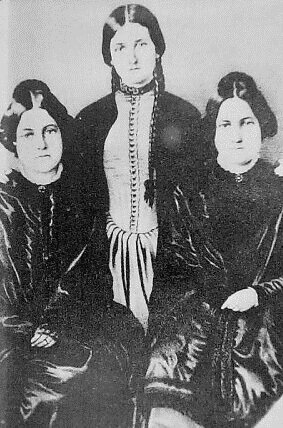
The notorious Fox sisters who are widely credited
with founding the movement called spiritualism in 1848

A Haunting
Haunted Hotels
American Paranormal
Celebrity Ghost Stories
Dead Famous
Extreme Paranormal
Ghost Adventures
Ghost Detectives
Ghost Hunters
Ghost Lab
Ghost Stories
Ghost Trackers
Ghostly Encounters
Ghosts Caught On Tape
Ghosts: Fact or Fiction
Haunted History
Haunted Homes
Haunting Evidence
Living with the Dead
Long Island Medium
Most Haunted
My Ghost Story
Mystery Hunters
Paranormal Cops
Psychic Witness
Scariest Places On Earth
The Haunted
The Othersiders
The Unexplained


What does this astoundingly long list tell us? That Americans in the 21st century believe in ghosts as much as their 19th century ancestors? I don't know if this is true, but I am certain that we love the possibility of ghosts.

Why? Well, for one thing, it's fun. It's fun to imagine that ghosts might exist. And it's scary and Americans love to be scared. (Just look at Stephen King's sales figures, if you don't believe this.)

A fascination with ghosts speaks to a deep and profound yearning in the human soul to know what happens after death. Most religions are grounded on this very basic fear and longing for an explanation. Plus the possibility of contacting or interacting in some way with the departed answers another kind of  longing in the hearts of all grieving people.

Of course, grief stricken people tend to be easier to exploit than more emotionally objective individuals and less-than-scrupulous 19th-century mediums were quick to capitalize on this fact. I tackled this issue in my recent novel, Seance in Sepia, when I explored the world of spirit photography. (Several posts in my blog archive on this subject can be found here. ) My current work in progress also poses the question of whether a spiritualist is committing fraud or not.

Stay tuned for weekly supernatural profiles in upcoming posts here at The Victorian West. First up will be the little girls who started it all: The Fox Sisters.

11/28/12

Congratulations to the Winners of Seance in Sepia

Three names were drawn last week for free copies of the new trade paperback edition of Seance in Sepia. They spanned the entire country--one from Maine, one from Colorado, and one from Washington state!

Happy reading, you guys and thanks again to all who stopped by the Victorian West to enter!

10/30/12

The NaNoWriMo Challenge Comes to Hanging Lake

I have signed up to participate in the National Novel Writing Month. I have never done this before but since I was writing my seventh novel anyway, I thought it might be a good way to stay motivated.

In a way, I have already started the book in the sense that I have been researching the setting and time period for more than a year. The characters have names and backstories developing and the plot is slinking its way towards an outline.

The working title of this new venture is "Hanging Lake." For those who live outside Colorado, Hanging Lake is a real place, located just east of Glenwood Springs.

I first visited Hanging Lake in the early 1990's. This photo was taken then of my two sons and their friends. The lake is accessed from a trailhead near Interstate 70 at a place called Dead Horse Gulch.

The hike is short--a little more than a mile--but very steep. One thousand feet in altitude is gained in that short distance so it becomes similar to climbing stairs for an hour. (No need to visit the gym's stairclimber after this day's workout.)

"Hanging" in this instance does not refer to anyone getting hanged, despite that fact that I am writing a mystery novel set in 1893. The name comes instead from the creation of the lake itself. A mineral-filled waterfall has splashed over the area for eons, the resulting layers of travertine on the side of the canyon wall eventually formed a basin which now acts like a giant sink, holding the water there.

The falls and the crystal clear waters of the lake are a dazzling sight--breath-taking, literally and figuratively--and well worth the climb to visit.

On November 1st, the fun begins. I think each participant in NaNoWriMo is psyched to challenge themselves to meet the grueling 50,000 word deadline on the 30th. For more information on NaNo, as it is fondly referred to by its thousands of participants, click here to visit the National Novel Writing Month website.

3/13/12

The Splendor That was Prairie Avenue

A great resource for information
about Prairie Avenue is this
"Images of America" book by
William H. Tyre.
One of the best perks to writing historical fiction is gaining a nodding acquaintance with fascinating places in the past. Some still exist today and can be visited, but most have disintegrated into a bygone time or only exist in a radically altered form.

The real life locale of much of the action in Seance in Sepia is a storied street in Chicago called Prairie Avenue. In 1875, the year my novel takes place, Prairie Avenue was the finest address one could hope to claim in that city. Chicago's elite all built mansions there after the Great Fire of 1871 destroyed much of the city center.

Household names like Marshall Fields, of department store fame, Phillip Armour of  meatpacking renown, and George Pullman of the train cars carrying his name, are just three of the millionaires who built mansions there which eventually totaled fifty in number.  Those built during the 1870's and 80's were styled in the manner the Second Empire with mansard roofs.

The home I describe my characters living in was inspired by the Daniel Thompson house. Readers of Seance in Sepia will recognize the third floor tower room in the drawing as the location where the lifeless bodies of Medora Lamb and Cameron Curtis Langley were discovered by Medora's husband, Alec Ingersoll, who was subsequently charged with their murders.

Viewing a photograph of this house and that tower room literally created the scenes of the novel in my mind. Sadly the mansion in question no longer exists. I visited the real Prairie Avenue on a trip to Chicago a number of years ago and found only remnants of its past glory. The monied interests of Chicago eventually migrated northward to the shores of Lake Michigan near the end of the 19th century. The encroaching heavy industry and the growing rail lines in the Prairie Avenue area made it a less than desirable place to live for families who could afford to live anywhere.

A few mansions remain and one, the Glessner House, is now operating as a restored Museum. It has a website listing events there:
http://www.glessnerhouse.org/

The elegance of Victorian Chicago can be experienced or at least imagined there.


Seance in Sepia is available for purchase from Amazon.com and other fine online retailers. Or ask for it at your local library. 

2/28/12

A Time Traveling Victorian Village...with a Killer View of the Rocky Mountains

Erie Village as viewed from the neighborhood park
Regular readers of this blog know that I write novels set during the Victorian era. That said, what better inspiration could such a writer have than living in a neighborhood which seems to have appeared from that time period, full blown, like a Victorian version of Brigadoon?

Imagine, if you will, a modern housing development whose homeowners' association encourages rather than proscribes unique and even eccentric house colors, that mandates large, covered front porches, and requires that house designs date from 1880 to 1910.

My own house is shown here. A white picket fence surrounds the front yard and the porch includes a full sized gazebo for three-season outdoor dining.

The neighborhood was conceived about fourteen years ago on farmland once owned by the Erie town doctor. It lies twelve miles east of Boulder and about twenty miles north of Denver.
Winter

The interior of the homes here can be as modern or traditional as the owner wishes. Naturally, given my love of all things Victorian, I favor as many historical design touches as possible, as long as they do not actually interfere with modern comfort and convenience.
My Writer's Nook


My home office, for example, offers all modern necessities, yet still conveys a homey warmth supplied by a fireplace and abundant window light.

The room is small--small enough to almost merit a designation as an "Inglenook" or chimney corner. An inglenook, historically, was an alcove containing a fireplace and a seating area. It was originally used for cooking, but in later times became a cozy spot to shake off the winter's chill and enjoy conversation and a warm beverage or two.

My writing companion
and silent critic relaxes nearby
Frank Lloyd Wright often incorporated such design features into his Prairie Style homes.

Though traditional inglenooks feature a centered fireplace with built-in seating lining both walls, my office feels cozy enough to at least be called a Writer's Nook.

My office also contains a lovely stained glass window, one of five in the home. Does all of this Neo-Victoriana inspire me and infuse my writing with its own unique flavor? Too early to tell. Though I have owned this house for two years, I have only just begun to live here full time.

I have previously written books in all sorts of surroundings and I sometimes think too much comfort is actually a detriment. It becomes so easy to let one's mind start wandering...and not in a creative way. Yet, there is much to be said for surrounding oneself with whatever sparks the imagination.

Living in Erie Village is a full-throttle immersion in the grace and beauty of a bygone moment in America's past and I feel so fortunate to call it home. 


Spring

2/19/12

A Short Vacation into the Long Past

Nearly a decade ago, this profile of me was published in True West Magazine. I recently came across it when moving my office files from my farm outside Kansas City to my present, now full-time, home in Colorado. The interview reflects my writing life as I viewed it in early 2003.

I read it over and was mildly surprised that I would probably answer many of the reviewer's questions exactly the same way today. I still love historical research, it is still one of the main reasons I love to write, and I still believe that America's ideas about the West--whether true or myth or something in-between--define much of our national character.

By the way, the novel referred to in the article as "The Eye Dazzler" was re-titled before its publication to become, The Second Glass of Absinthe. And my first horse, Solomon Spring, also mentioned below, is still in the family. He is now cared for  by my daughter-in-law, who is studying to become a veterinarian. Final declaimer: My hair is no longer brunette!

11/14/11

The Strange World of Spirit Photography

Read more about Seance in Sepia here.

In my newest Victorian mystery novel, Séance in Sepia, I invite the reader to enter the strange world of spirit photography. This was a very real phenomenon that flourished during the second half of the Nineteenth Century and well into the early Twentieth.

The first commercial spirit photographer set up shop in Boston in the early 1860's. His name was William Mumler and his photographs were an instant sensation. He soon moved to New York to further his reputation and success. The massive loss of life during the Civil War spurred interest in making contact with the departed. Séances were more than a popular parlor entertainment. A large percentage of the population sincerely believed they could contact spirits of deceased loved ones using the services of a medium.

Mumler began to conduct séances in his photographic studio and, because the technology represented by the new invention of photography, his spirit photographs had added credibility.  Technology was scientific, and science couldn't lie, right? 

His most famous sitter was the recently widowed Mary Todd Lincoln whose portrait seems to show a spectral Abraham Lincoln standing behind her. There were doubters, of course. P.T. Barnum and others charged Mumler with fraud, claiming that some of his ghost images belonged to living persons. 

The May 8th, 1869, issue of Harper's Weekly Magazine reported, "If there is a trick in Mr. Mumler's process it has certainly not been detected as yet. To all appearances spiritual photography rests just where the rappings and table-turnings have rested for some years. Those who believe in it at all will respect no opposing arguments, and disbelievers will reject every favorable hypothesis or explanation. " 


Mumler was acquitted, but his reputation was damaged by the charges. Spirit photography's most famous proponent was Sir Arthur Conan Doyle, the creator of Sherlock Holmes. In 1925, he wrote "The Case for Spirit Photography." 

He also defended a contemporary spirit photographer of his named William Hope. Some of Hope's photos inspired my descriptions of spirit photographs in Seance in Sepia.

Read the first two chapters of Séance in Sepia by clicking here.

Available from Amazon.com.

11/2/11

Consumed by Consumption: TB and the Victorian West in Mercury’s Rise

I am pleased to present a guest post by award-winning author Ann Parker. The fourth entry into her wonderful Silver Rush Mystery series, Mercury's Rise, has just been released. She and I , along with mystery novelist Beth Groundwater, will be appearing together on November 17th in Longmont, Colorado, in an event hosted by High Crimes Books. 
Read the fascinating historical underpinnings of Ann's intriguing new novel:
****************************************************************
Ann Parker, posing with
a map old Leadville, CO
Although most of my Silver Rush historical mysteries are set high in the Rocky Mountains in 1880s Leadville, Colorado, my latest novel, Mercury’s Rise, has my protagonist Inez Stannert heading down to Manitou Springs to reunite with her young son and his guardian, Inez’s beloved sister.

As I nosed about, getting my bearings for this new location, I became intrigued with the “selling” of this area of the Victorian West—particularly of Manitou Springs—as a health resort and tourist destination in the mid- to late-1800s. Colorado Springs was hyped as “Little London,” while Manitou Springs was touted as the “Saratoga of the West.” Promotion and puffery was hot and heavy in nearly every period piece of documentation I read, from the backs of cabinet cards to books such as Tourist Guide to Colorado in 1879 by Frank Fossett and New Colorado and the Santa Fe Trail by A.A. Hayes, Jr., published 1880.  The latter quotes one fellow who praises the healthful effects of the weather and mineral springs, adding, “I came here [Manitou] from Chicago on a mattress.”

Many of those coming to the area were, like the fellow from Chicago, “chasing the cure,” that is, looking for relief from tuberculosis, aka consumption, the white plague, the wasting disease, and phthisis. TB was the leading cause of death in the U.S. in the 19th century. From the beginning of the century thru 1870, it was the cause of 1 in 5 deaths, or 20 percent. You need only read about the scourge of the disease, before the discovery of antibiotics effected a true cure, to shudder and pray that “superbug” tuberculosis does not breach the current spectrum of antibiotics. As a science writer, I appreciate the power of metaphor and analogy to make a point, and found this passage in Transactions of the American Medical Association, 1880, written by Ephraim Cutter, M.D., to his colleagues, a real eye-opener:

"It is estimated that one-quarter of the human deaths is caused directly or indirectly by what is commonly called consumption…I find I can write my name readily ten times in one minute…it would take 1 year, 213 days, and 16 hours of unintermitted writing to inscribe the names of this host, if on the average they consisted of thirteen letters. Suppose the vast company could be marshaled in rows four deep and two feet apart, this host would reach 770 miles in length, and occupy 10 days and 17 hours in passing a given point at a continuous rate of three miles an hour.”

It boggles the mind. It’s also hard to imagine that anyone living in the 1880s remained untouched by the effects of the disease. In fact, one of the reasons I decided to tackle the topic of tuberculosis comes from my own family’s history: my grandfather was 9 years old and his sister 13 when their mother and father died of tuberculosis in 1892. Thus orphaned, they were taken in and raised by an aunt and uncle. My grandfather’s story is not unique, and was part of what started me wondering about the effects of this dread disease on the families and individuals of the era. And truly, consumption was everywhere, and patients, families, and physicians were desperate to find a cure.

The 1880 Transactions are full of papers on tuberculosis treatments and research, including “The Salisbury Plans in Consumption—Production in Animals—Rationale and Treatment,” “Artificial Inflation as a Remedial Agent in Diseases of the Lungs,” and “Some Remarks on the Lesions of the Larynx in Phthisis.” The so-called causes and cures ranged far and wide. For instance, in 1881 in the textbook The Principles and Practice of Medicine, some of the causes put forth were hereditary disposition, unfavorable climate, sedentary indoor life, defective ventilation, deficiency of light and “depressing emotions.” Cure routines ranged from reliance on nourishing food, fresh air, and exercise, to the “slaughterhouse cure,” i.e., drinking the blood of freshly slaughtered oxen and cows (reported in Denver in 1879), to patent medicines and nostrums containing such ingredients as cod-liver oil, lime, arsenic, chloroform, the ever-present alcohol, and yes, mercury, even into the 1920s.

Another “cure” proposed by a well-respected physician in 1875 was—I kid you not—growing a beard. (You can find that particular medical treatment in Addison Porter Dutcher’s Pulmonary Tuberculosis: Its Pathology, Nature, Symptoms, Diagnosis, Prognosis, Causes, Hygiene, and Medical Treatment, “Chapter 30: A Plea for the Beards; Its Influence in Protecting the Throat and Lungs from Disease,” pg. 304.)

Is it no wonder, then, when Inez travels to Manitou for her family reunion she hears much about the wonders of the mineral waters and their miraculous health effects, and also finds out about some not-so-miraculous treatments being pedaled to the desperate and the dying? And, since Mercury’s Rise is a mystery, she discovers that not all the deaths are natural …


************************************************

Ann Parker is a California-based science/corporate writer by day and an historical mystery writer by night. Her award-winning Silver Rush series, featuring saloon-owner Inez Stannert, is set in 1880s Colorado, primarily in the silver-mining boomtown of Leadville. The latest in her series, MERCURY’S RISE, is out November 1. Learn more about Ann and her series at http://www.annparker.net

MERCURY’S RISE and the other Silver Rush mysteries are available from independent booksellers, amazon.com, Barnes and Noble and other places where mystery books are sold.

Leave a comment on this post to be eligible to win a Silver Rush mystery prize! Winner will be announced later this week. To see the rest of Ann’s blog tour, check out her Appearances page on her website.